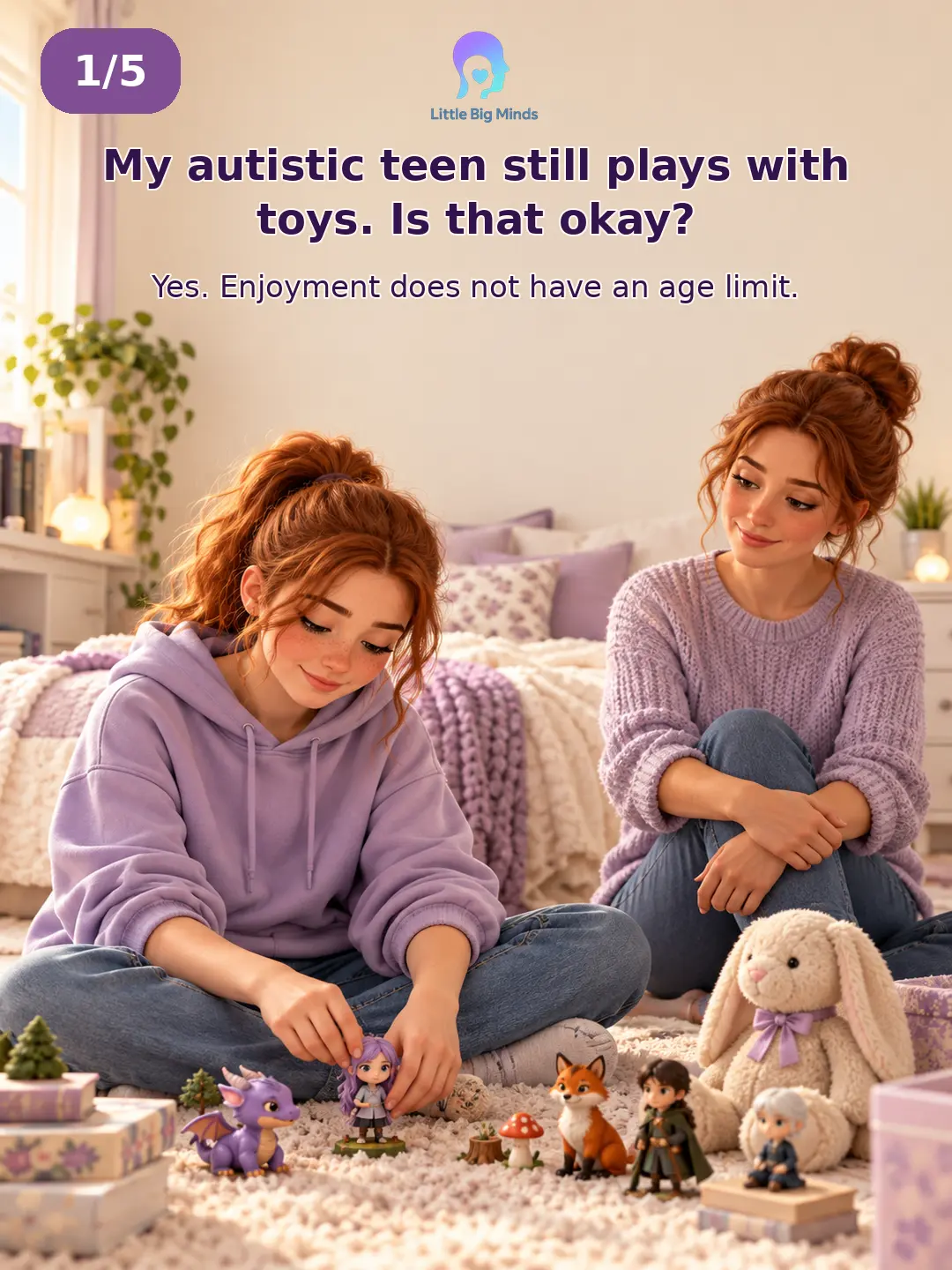
A teenager can enjoy something associated with childhood and still be growing, learning and becoming more independent in their own way.
Why toys may still matter
For some autistic teenagers, familiar toys, characters, collections or imaginative play are simply enjoyable. They may also provide a predictable activity after a demanding day, support sensory comfort, create a safe space for imagination or help the nervous system settle.
Autistic interests can be deep and absorbing. The National Autistic Society describes focused interests as potential sources of comfort, learning and growth. The important question is not whether an interest looks typical for a teenager, but what it means to this particular young person.
Something does not become harmful simply because other people think your teenager should have grown out of it.
Look at the whole picture
Playing with toys on its own is not a reason to worry. It can help to consider the activity alongside your teenager’s wider wellbeing.
Check for ordinary safety concerns, without treating the interest itself as a problem.
Your teenager’s enjoyment and perspective matter more than other people’s assumptions about age.
It may offer joy, creativity, familiarity, sensory comfort or recovery time.
Notice sleep, eating, communication, distress, daily activities and connection, not just the toys.
Respond with curiosity, not embarrassment
Try asking, “What do you enjoy about it?” or “Would you like me to join you, or would you prefer some space?” A calm question can tell you far more than an instruction to act their age.
Respect privacy too. Your teenager may be happy for family to know about an interest but not want it discussed with friends, school staff or relatives. Let them lead where possible. Protecting their dignity does not mean teaching them that the interest is shameful.
What may be unhelpful
- Removing a valued toy purely to make your teenager seem more mature
- Teasing, comparing them with peers or discussing the interest publicly without permission
- Assuming that enjoying toys means they cannot understand anything complex
- Turning every preferred interest into a reward that must be earned
When to check in more closely
The toy is not usually the concern. Pay attention if this is part of a sudden change and your teenager seems distressed, withdrawn, unable to manage usual daily activities, or markedly different in their sleep, eating or communication.
Start with a gentle conversation and consider speaking with their GP or another professional who knows them if you remain concerned. The aim is to understand what has changed, not to take away something that may be helping.
Watch the one-minute guide
A calmer way to see it
The matching Parent Support video can be watched here without opening the YouTube app.
Trusted further reading
- National Autistic Society: focused and dedicated interests
- National Autistic Society: order, predictability and routine
- Leicestershire Partnership NHS Trust: hobbies and interests for autistic people
- NHS: signs of autism in children and young people
Keep exploring